
Explainer · July 17, 2026 · 5 min · By Beatriz Holmgren
Breast implant profiles and projection: the dimension patients overlook
Two implants can hold the same volume and still look nothing alike. Profile, meaning how far an implant projects off the chest, is the second dimension of implant geometry, and it decides whether a given volume reads as a soft slope or a full forward push.
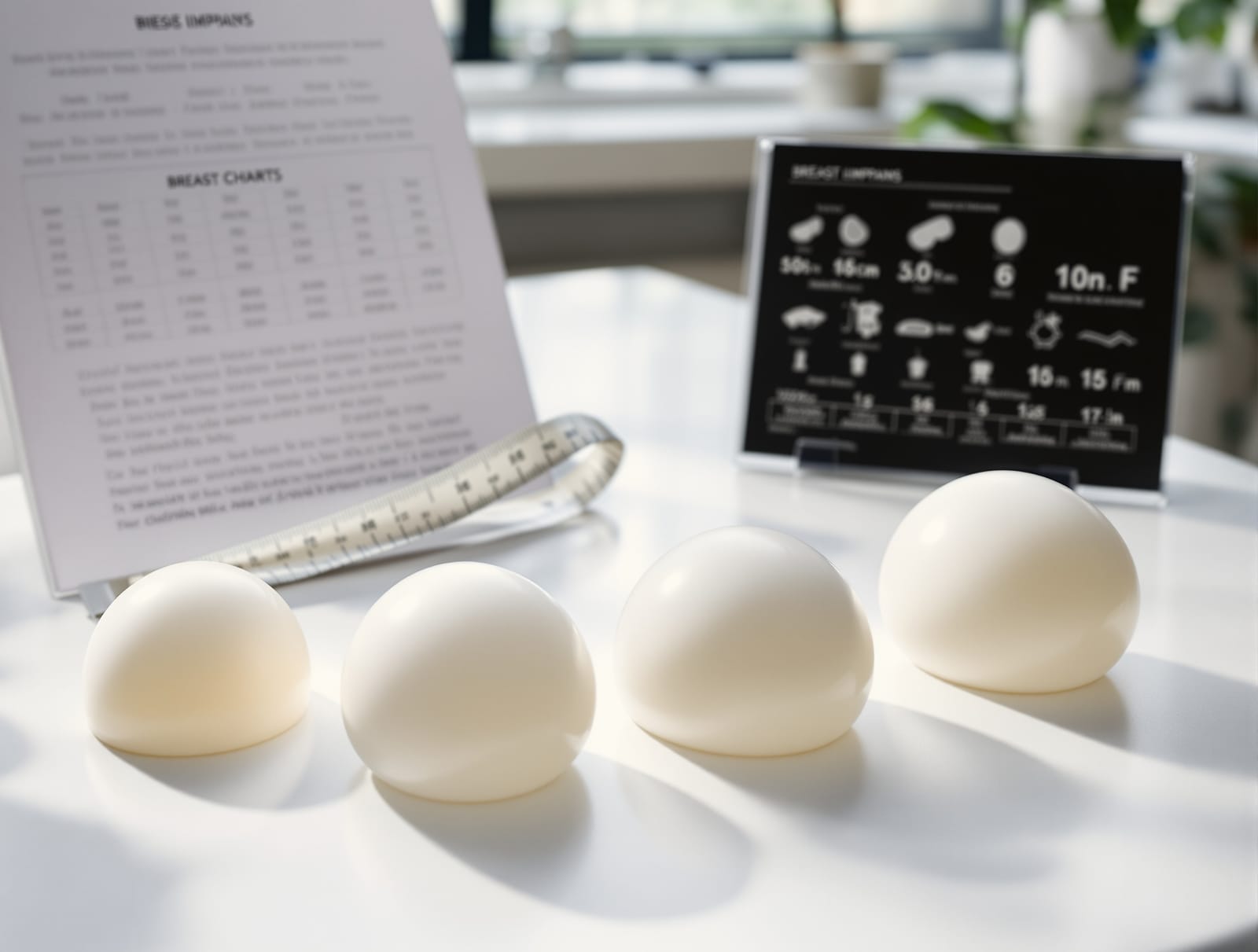
Two breast implants can hold the same number of cubic centimeters and still look nothing alike on the same chest. That surprises patients who arrive at a consultation convinced that volume is the whole story. It is not. Profile, the industry word for how far an implant projects forward off the chest wall, is the second dimension of implant geometry, and it decides whether a given volume reads as a modest natural slope or a full rounded forward push. Learning to think in profiles is what separates a patient who chooses by cup size from one who can actually describe the result she wants.
What profile really measures. Every round implant is defined by two numbers that trade against each other: base width, meaning the diameter of the implant where it meets the chest, and projection, meaning how far it stands out from that base. Hold volume constant and those two numbers move in opposite directions. A wide, low-projection implant spreads its volume across the chest and sits flatter. A narrow, high-projection implant of the same volume concentrates that same fill into a tighter forward push. Profile is simply the manufacturer's shorthand for where a given device sits on that spectrum. The physical properties of the gel matter too, which is why profile is best understood alongside the fill and cohesivity choices covered in saline vs. silicone implants.
The profile ladder, low to extra high. Manufacturers group round implants into named tiers, and while the labels vary slightly by brand, the ladder runs roughly the same way: low profile (wide base, minimal projection, the flattest look), moderate profile, moderate plus, high profile, and extra high or ultra high (narrow base, maximum projection, the most dramatic forward push). The FDA's overview of breast implant devices reflects how many shape and dimension options now clear the market. A 350cc implant exists in nearly every tier, so quoting a volume without a profile describes only half the device. This is exactly why cup size is such a poor planning language, a point our explainer on how implant size actually gets chosen makes in detail.
Base width is the anchor, not projection. Here is the part patients rarely hear: surgeons usually pick base width first and let profile fall out of it. The reason is anatomical. Your chest has a natural breast footprint, and an implant whose base is wider than that footprint pushes toward the armpit and the cleavage in ways that look and feel unnatural. An implant whose base is too narrow leaves a gap at the sides. So a careful surgeon measures your existing base width, selects an implant base that respects it, and only then works out which profile delivers the projection and volume you are after within that constraint. Mayo Clinic's patient guidance on breast augmentation stresses this kind of individualized planning over a target cup size, and it is a good filter for judging a consultation.
How profile interacts with volume and tissue. A higher profile is often the only way to reach a large projected look on a narrow chest, because there is simply no room for a wide base. But projection has costs. Higher-projection implants concentrate more weight and pressure over a smaller area of tissue, which over years can contribute to thinning of the overlying skin, more visible rippling in thin patients, and more downward stress on the lower pole. Lower and moderate profiles distribute their load more gently and tend to age more forgivingly in patients with limited soft tissue coverage. The amount of tissue over the implant is also governed by where the implant sits, which is why profile decisions interact with the pocket choices explained in how implant plane actually changes outcomes.
What profile does not fix. Profile controls projection, not droop and not shape. A patient whose nipple sits below the breast fold will not be lifted by a high-profile implant; she needs the lift discussed in breast augmentation vs. breast lift. And profile is separate from the round-versus-teardrop question, which is about the silhouette of the device rather than how far it projects, a distinction our piece on cohesive gel implants and the shape question draws out. Confusing these three variables, projection, lift, and shape, is one of the most common ways consultations go sideways.
How to talk about profile in a consultation. Skip the cup-size vocabulary. Instead, bring reference photos and describe the result in plain terms: do you want the volume to sit forward and rounded, or spread wide and softer? Ask what your measured base width is, which profiles fit within it, and what the projection trade-off means for your particular tissue thickness over the next ten years. A surgeon who answers with your measurements, sizers you can try in a bra, and a clear explanation of why one profile suits your frame is planning properly. One who reaches straight for a volume number is skipping the dimension that will most determine how the result actually looks.
The takeaway. Volume tells you how much implant. Profile tells you what that volume will do to your silhouette. The two together, chosen against your own base width and tissue quality, are what produce a natural or a dramatic result, and either can be the right answer depending on what you want. Patients who understand profile stop asking for a cup size and start describing a shape, which is the language surgeons can actually build from.
Related reading: How implant size actually gets chosen.