
Dispatch · February 4, 2026 · 6 min · By Sylvie Templeton
Fat transfer breast augmentation: implants vs. your own fat
A natural-tissue alternative for modest enhancement, with real limits.
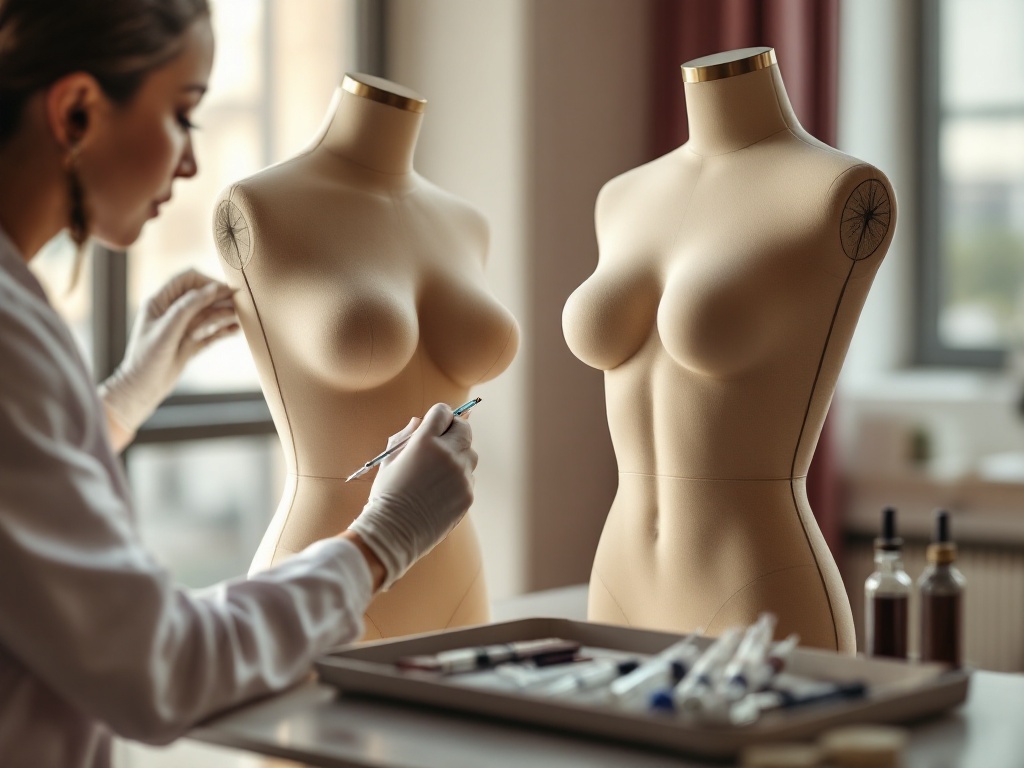
Not all breast augmentation uses implants. Fat transfer augmentation moves a patient's own fat, harvested by liposuction, purified, and injected into the breasts, and it occupies a distinct niche with clear advantages and limits.
The appeal is natural tissue and a bonus: the result uses your own fat, feels entirely natural, leaves no implant to rupture or replace, and the liposuction contours the donor area at the same time. The limits are equally real. Fat transfer provides only a modest size increase, typically a fraction of what implants achieve, because a meaningful portion of transferred fat is reabsorbed, and you need enough donor fat to harvest. It is best for women wanting a subtle enhancement, improved shape, or correction of minor asymmetry, not a substantial size jump.
Fat transfer also requires the surgeon to overfill to account for reabsorption, and the final volume settles over months. For the right candidate, someone wanting a natural, modest enhancement with no implant, who has adequate donor fat, it is an excellent option. For a significant size increase, implants remain the answer. The choice between implants and fat is fundamentally about how much enlargement you want and whether you prefer a device or your own tissue, a decision a surgeon offering both can help you make honestly.
Related reading: How long breast implants last and when to replace them.
Further reading: Adipose-derived stem cell enrichment is counter-productive for the majority of women seeking primary aesthetic breast augmentation by autologous fat transfer: A systematic review (J Plast Reconstr Aesthet Surg 2020); Complications of Fat Transfer for Breast Augmentation (Aesthetic Plast Surg 2017); Autologous Fat Transfer for Breast Augmentation: A Review (Dermatol Surg 2016).